The manual, chapter by chapter.
Everything Grow One does, in steps you can follow on your phone — and, under each one, the words that make your assistant do it for you. Read it before you buy, or keep it open while you set up.
Start here
Grow One is a chat. Almost everything in this manual can be done by typing or saying a sentence. The menus exist for the moments you would rather look than ask.
- Setup is a short conversation. On your first open the assistant asks who it is helping, what you do, how it should sound and which emails to show you. One question per screen; later, the instructions live under Settings→Your assistant (with a Redo setup button), and the email choices under Settings→Email→Email Preferences.
- Two menus. ☰ at the top-left is where you go: Chat, Needs you, Radar, Briefings, Planner, Inbox, your chat history, and, once set up, WhatsApp, Money, My apps and Website. ⋯ at the top-right is how the assistant is set up: Contacts, Guide and Settings.
- Type, dictate, or talk. The small mic next to the green button dictates into the text box. When the box is empty, the green button opens Voice mode: press and hold to speak, release to send, and it answers out loud.
- Add a photo to any question with the + at the bottom-left. A new conversation starts from the notepad icon next to ⋯; old ones live in ☰→Chat history.
- English or Spanish is one switch under Settings→Language & appearance, and every screen follows it.
Chat
Connect Gmail or Outlook once. Your assistant reads what arrives, keeps only the mail that needs you, writes the reply in your voice, and never sends anything without your tap.
- Connect. ⋯→Settings→Account connections→Connections→Gmail or Outlook→Connect. Gmail is one Google sign-in in the browser and Google Calendar comes with it; Outlook is one Microsoft sign-in (outlook.com, Hotmail or Microsoft 365), mail only for now. Either imports your last 7 days, then checks every 5 minutes. The first import takes 10–15 minutes and you get a notification when it is ready.
- More than one mailbox? Add another Gmail or Outlook from the same screen. The Creator plan allows up to 3 in total; new mail sends from your default account.
- Read. ☰→Inbox. Tabs: New, AI Drafts, Sent, Done. Chips such as Bills, Receipts and Travel narrow the list, and the ★ Newsletters section keeps your reading apart. An email is marked as needing a reply only when a real person is waiting: receipts, newsletters and "thanks!" are left out.
- Nothing is lost. "What comes in" shows everything that was screened out. Tap a sender there to bring them in for good. Filed wrong? Open the email, tap its category chip, choose "This is actually…". One tap fixes it and teaches the assistant.
- Reply. Open an email → Reply with AI → add a hint if you like (tone, an offer) → edit → Send. Under the draft, ✨ Polish with AI offers Shorter, Friendlier, More formal, or "Did I miss anything?".
- Let it draft ahead. Settings→Email→Email Preferences→AI Reply Mode→AI Auto-Draft writes replies before you open the inbox; they wait in the AI Drafts tab. The same screen holds your signature, "What should the Hub bring in?", what to watch for (bills, receipts, travel), your reading topics and the senders it has learned.
Needs a reply · 2
Sorted quietly · 14
Calendar and planner
Describe the event in plain words. A card shows what the assistant understood, and nothing lands on your calendar until you tap Add to Calendar.
- Schedule by saying it. "Dinner with Luca Friday at 7" in chat or voice. The card shows title, time, and any conflict with what is already there. Multi-day plans become an all-day span.
- Invite people. Mention their email in the request and Google sends the invitation when you confirm. Or open any event → People → type an email → Invite. Invitations you receive appear as a yellow banner at the top of the Planner: Accept, Maybe, or Decline.
- The Planner. ☰→Planner. Tabs: Today, Upcoming, Anytime, and Calendar (Day, 3-Day, Month). Type anything in the bar at the top; tasks save instantly, anything with a time becomes a card to confirm. Weeks run Monday to Sunday.
- Tasks. The green + creates one by hand. Tap a task's circle to complete it; Undo stays for 5 seconds.
- A schedule from a photo. Planner → the camera inside the add bar → photograph a flyer, a school calendar, a work rota. You get a checklist of the events it found; untick or edit any, then Add. Undo removes exactly what was added.
- Trips. When a flight or hotel confirmation lands in your mail, a trip pill appears in the app for the days you are away, with the day's items, reservations, where you are staying and the flight home. Your home base lives under Settings→Profile.
Calendar
Meetings
Record the meeting on your phone. A minute after you stop, you have a summary, who said what, the decisions, and the commitments turned into tasks.
- Record. Tap Meeting notes on the chat bar → New note → A recording → Start meeting. The first time, a short "Before you record" screen explains consent. Then say who is in the room: Just me starts at once; Me and other people asks "Does everyone know?" and can announce the recording out loud for you.
- Jot while it records. Your notes shape the summary. Tap Stop when the meeting ends.
- The note saves itself 20–60 seconds later: summary, action items, decisions, the full transcript, and Suggested tasks. Tap + on a suggestion to make it a real task.
- Name the voices once. Open Manage, then the Speakers section: play each voice and name it ("It's me" for yours). Future meetings recognize everyone on their own.
- Already have a recording? Upload audio file transcribes a recording; Paste text takes a Zoom transcript or minutes.
- Ask your notes. The Topics tab groups sources (meeting notes, pasted text) into a topic. Chat with this topic answers only from those sources and cites which one. With Notion connected, Manage→Save to Notion sends a note to your workspace.
Meeting · Venue walkthrough
Contacts and people
Everyone you email, meet or write about ends up in one place. Before a call, ask for a brief on the person and walk in knowing where things stand.
- Open Contacts. ⋯→Contacts. Search by name, email or company. Add creates one by hand: name, email, company, phone, relationship, birthday, notes. Everything except the name is optional.
- Everything about them, in one place. Emails, meeting notes, tasks and saved thoughts that mention a person show up on their contact page, in tabs.
- Ask for a brief. "Catch me up on Dana" pulls her contact details, recent emails, meeting notes, open tasks, saved thoughts and anything scheduled with her into one answer. Works with a first name, a full name, or "Dana at Acme".
- Tap through. A contact's page has tabs for their Emails, Notes, Tasks, Meetings and Thoughts, and a Generate summary button that reads them all for you.
People
WebsiteEvery plan
Tell it what the page is for. It builds a page in your brand voice, you publish it at pages.growone.io, and the form sends people straight into the app. It is not meant to replace a full website — but if you don't have one, it is a good way to get started, and with a home page plus a few linked pages it can be a basic website for most small businesses.
- Open it. ☰→Website. You land on Templates: pick one, or type below what the page is for ("a webinar page for Oct 30 with a sign-up form"). It may ask two or three questions first; answer, or tap "Skip and build". A build takes a moment and keeps going if you leave.
- What it knows about you. My business (About me on a personal account) shows the name, business type, brand colors, tone, phone and website the builder uses. Set the type and colors there; industry rules and fonts follow. Already have a site? The first build asks whether the page should match its look or start fresh ("Match my site" / "Start fresh"); matching copies its colors, fonts and mood (a booking or listing page lends only its colors and logo). Paste a link to your own site in the bar and it is matched the same way; "Rebuild my site's page" remakes your landing page here. Other people's sites are never copied.
- Edit. The Edit tab: Text (tap any text or button), Sections (delete, duplicate, or ask for a change to just that section), Add, Theme, Tweaks, with undo and redo. Or type "make the hero darker" or "add a pricing section" in the bar and it edits the page, keeping everything else.
- Publish. The first time you see your address, pages.growone.io/your-name, and can change the last part once. After that it is fixed so QR codes keep working. Live pages update within a minute of every change; ● Live takes one offline. Then Copy link, Share, QR, Open, or set the link preview people see in Messages and WhatsApp.
- Forms. A page with a form collects name, email, phone and message. At publish you choose "Alert me and draft a reply" or "Just save the contact". Submissions appear under My pages→Leads (Responses on a personal account). When more than one page has submissions, tap a page chip at the top to see just that page's.
- Reply. Open a submission → Reply with AI drafts the answer in your voice → edit → Send from your Gmail. Without Gmail it opens the draft in your Mail app and asks whether you sent it. Call and WhatsApp buttons appear when the visitor left a phone. Every page carries a small "Made with Grow One" footer.
- Linked pages. The builder makes one page at a time. Under My pages, tap "Make home" on one page; every other published page joins its shared menu on the live site automatically (drafts never show). The menu appears once two pages are published, on the live site only, never in the editor, and the home page is listed as "Home". The menu lives inside each page's own header: on phones a ☰ in the corner opens the list of pages; on a computer the links sit in the page's nav next to its own links. On the phone, My pages shows only your pages and their responses — the assistant and the bar come back on Page or Edit. "In menu" takes a page out, "Add to menu" puts it back, ↑↓ orders the menu, it uses each page's title (keep them short), and each page keeps its own address. "Create a linked page" in the bar starts the next one.
Website
WhatsAppCreator
Your WhatsApp Business number, watched by your assistant. Customer messages are summarized, replies are drafted, and your WhatsApp app keeps working exactly as before.
- Use a Business number. A personal WhatsApp converts in two minutes, free: install the WhatsApp Business app and accept migrating your number. Chats and contacts carry over.
- Connect. ⋯→Settings→Account connections→WhatsApp→Connect my WhatsApp Business. You sign in with Facebook first (WhatsApp belongs to Meta), Meta's wizard links your business and number, and you confirm from the WhatsApp Business app.
- Read and reply. Once connected, WhatsApp appears in the ☰ panel next to Inbox. Open a thread → ✨ drafts the reply → you tap send. Save an unknown number with + Add contact. Group chats never appear.
- Nobody waits too long. If a customer waits two hours or more, you get a reminder, and waiting customers show up in your morning briefing.
- Cost, plainly. Receiving is free, and replying within 24 hours of a customer's message is free. Only a message you start outside that window is billed by Meta.
WhatsApp · business number
Money
Connect Stripe once. Ask who paid, create an invoice by describing it, send it from your own Gmail. The connection can read and create invoices; it can never charge, refund or pay out.
- Connect. ⋯→Settings→Account connections→Stripe→Connect. Stripe opens with a key named "Grow One" and its permissions pre-ticked. Tap Create key, copy it, paste it in the app. Stripe itself enforces what that key cannot do.
- Ask. "Did Jenn pay?", "who owes me?", "what came in this week?", "what's coming in monthly from subscriptions?". Answers are exact figures from your Stripe.
- Invoice by describing it. "Invoice Jenn $500 for the September retainer." If something is missing it asks one question. A card shows customer, line items, total and due date; nothing exists until you tap Create invoice.
- Send it. Tap "Draft the email with the pay link". The email goes from your Gmail with your logo or business name, the amount, a Pay invoice button and the PDF. Review, then Send. Your customer pays on Stripe's page.
- Recurring. "Invoice Jenny $600 every month on the 1st." Each period the invoice is created, the email drafted, and you get a "ready, tap to send" card. Pause or stop under ☰→Money→Recurring.
- The Money screen. ☰→Money: Open, Overdue, Paid, Recurring, Payments. Tap an invoice for the pay page, the PDF, Copy link, Remind or Draft email. A payment landing, a failed payment or a dispute notifies you, and the morning briefing carries a MONEY section. Bills and receipts from your mail are watched too, with the amount and due date pulled out.
Money · this week
Second Brain
Half-formed ideas, things a client said, the name of that place. Save them in a second, then ask for them the way you would ask a person.
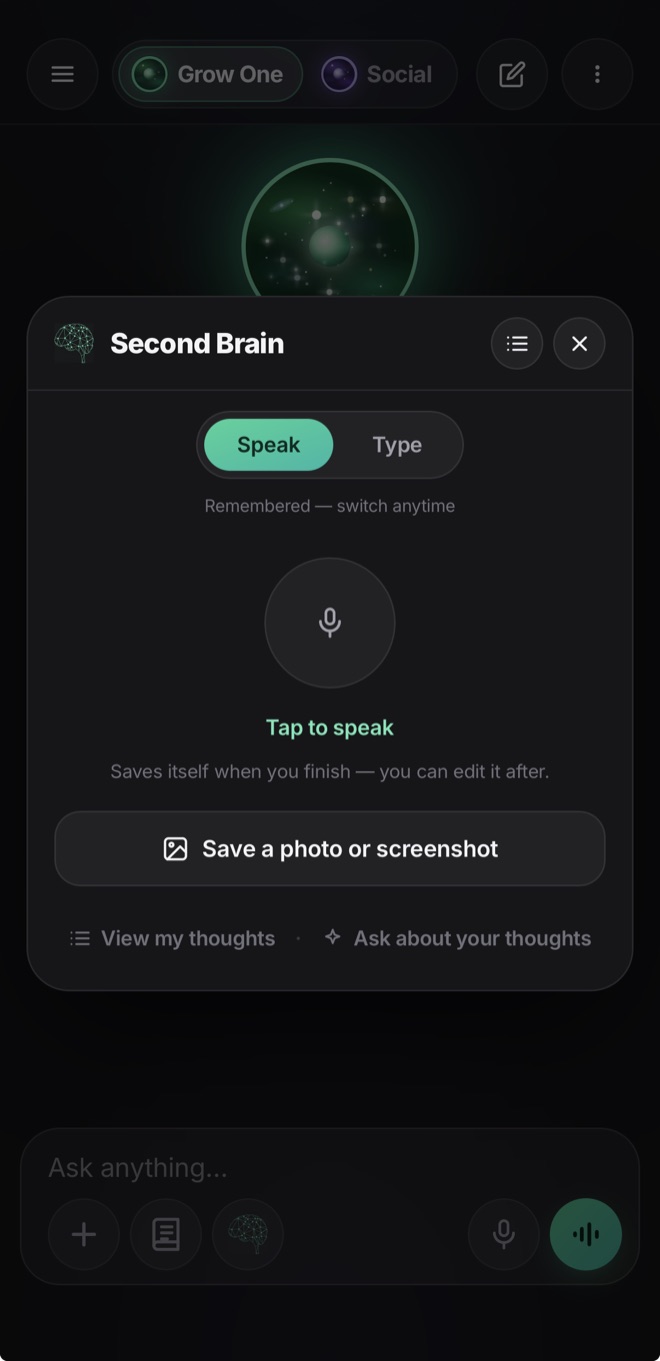
- Turn it on. Settings→Your assistant→Second Brain. A small brain button appears on the chat bar. If the switch is not there yet, it has not been enabled for your account; ask us.
- Capture. Tap the brain → speak it, type it, or use a photo or screenshot (it keeps what the image says, not the image). You can add a note first (“just the phone number”) to say what to keep. Each thought files itself by category (ideas, clients, finance, marketing, personal, travel…) and by the people it mentions.
- Ask. Tap "Ask about your thoughts". The chat shows a "Using your thoughts" chip and answers only from what you saved. The × on the chip returns to normal chat.
- Browse. "View my thoughts" lists everything with search, and a map of how your ideas connect.
What happens on its own
Some of Grow One runs without being asked. This chapter is not a how-to; it explains what arrives, when, and where to turn each piece down.
- The morning briefing. One message a day, 7:30 on weekdays unless you change it, with only the sections that have something in them: tasks due, today's calendar, mail waiting, meetings to prepare, WhatsApp customers waiting, money, and your apps when there is something to say, with the whole week on Mondays. Time and days live under Settings→Notifications & reminders→Daily briefing. Past briefings are in ☰→Briefings.
- Needs you. ☰→Needs you is the list of things waiting on you as cards: an email to answer, a follow-up that went quiet, meeting prep, a task at risk, an invite to answer, a customer on WhatsApp. Act on a card or dismiss it; dismissed ones can be restored from the Dismissed list. A card you keep closing stops returning to the chat but stays here, and waiting cards expire on their own after two weeks.
- Reminders. The same Settings screen lists each kind (unanswered emails, follow-ups, meeting prep, task deadlines and more) with its own switch, and "How proactive?" sets the pace: Balanced caps them at about 3 a day, Everything has no cap.
- Quiet hours. "Hold notifications at certain hours", a from and until time, and "Quiet all weekend" at the top of that screen. Or say it: "don't bother me from 9 pm to 7 am" sets the same thing.
- Radar. ☰→Radar watches one thing daily and stays quiet until it changes, or delivers a digest on a schedule. Up to 5 active. Findings show up in Needs you.
- A suggestion or two a day. Your assistant may offer a helpful card in the chat, at most a couple a day. It only suggests; nothing happens unless you tap it.
Needs you · today
Get your mornings back.
Download it, answer a few questions, and it starts working today.